Settling the body
From Meditation textbookAbout 8 min read
1. Settling the body is the basic work
Although the main meaning of meditation is gathering the mind, the foundation of gathering the mind is precisely perfecting the sitting posture of the body. It is no accident that the Buddhas of the three times all sat in meditation in the full lotus posture. That posture is closely connected with the work of subduing the inner mind.
Some people take an easy-going view of posture and hold that one may sit in any way; they have not seen clearly the importance of the full lotus posture. It is true that outside the formal sitting hours we may practise in every posture, standing or sitting in any way. But in the main practice, the full lotus posture is obligatory.
Body and mind are a unified whole. Whatever concerns the body concerns the mind, and vice versa. When we want to preserve the health of the body, doctors always advise us to keep the mind healthy and calm. When we want to subdue the inner mind, the Buddha teaches us the work of settling the body as the foundation of our effort.
2. Sitting in the correct posture
Before sitting in meditation, we may bow to the Buddha, make a vow and ask for his protection.
Spread a sitting mat on a level surface. The size of the mat need only be larger than the area we sit on. The mat may be made of thick cloth, woven matting, or a thin cushion a few centimetres thick, so long as it keeps damp from the ground from seeping up and eases pressure on the flesh. Later, some practitioners also use a cushion to raise the buttocks, called a bồ đoàn (zafu). The cushion gives us the feeling of having less need to strive to keep the back straight, because the buttocks have been raised a little. However, in exchange, the cushion also has a downside. It is precisely the effort of keeping the back straight that, over time, makes our mental strength stronger. Sitting on a cushion loses this advantage. Moreover, when sitting on a cushion, the weight of the body is concentrated on only three points, the buttocks and the two knees, which over time causes uncomfortable pressure. Sitting without a cushion, the weight of the whole body is spread evenly over the buttocks and the two thighs, and so is more comfortable. Wherever we go, we then do not need to carry a bulky cushion. Do not wear tight clothing. If the weather is cool, we may sit in the main hall wearing the lay robe. A solemn setting helps us to receive the protection of the Triple Gem more easily.
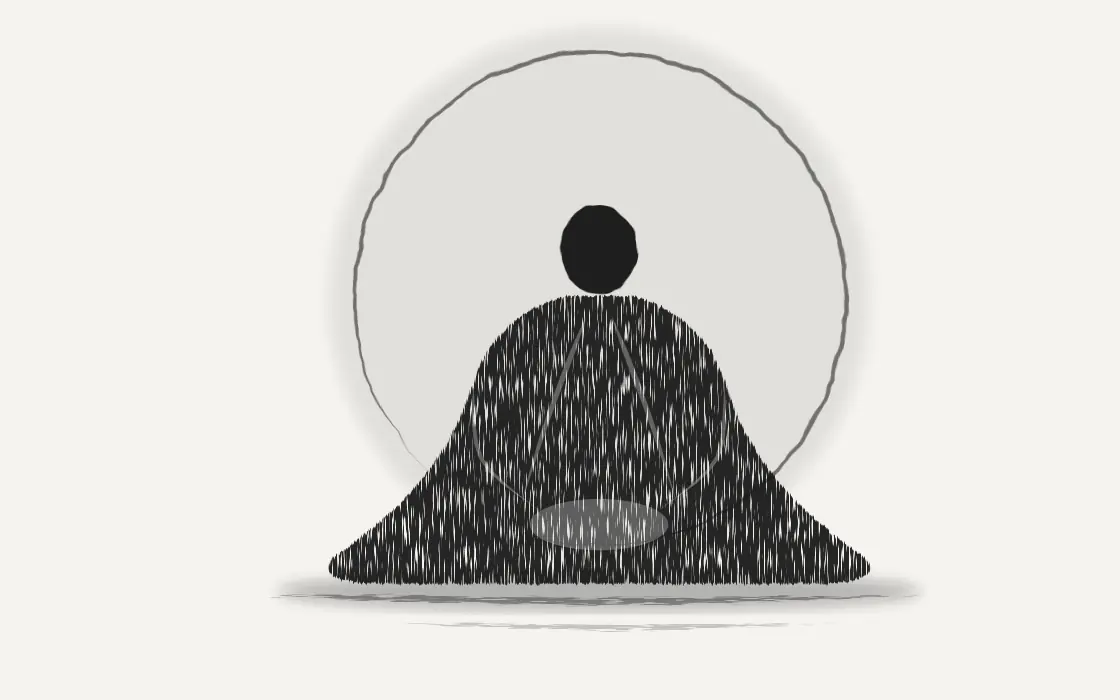
In the full lotus posture, we place the left foot on the right thigh, then pull the right foot up and rest it on the left thigh (in fact the right foot rests across the whole of the left thigh). Because the legs are crossed, the right foot presses down very strongly, so that the joint of the left foot bears very great strain. Those whose tendons and joints of the foot are weak, or elderly people whose tendons are also weak, cannot bear that kind of tight pressure; it is very painful and they cannot sit for long with peace of mind. Therefore in that case the practitioner is allowed to use a folded cloth as extra support directly beneath the joint of the left foot. But do not overuse padding by making it too thick; just enough is enough.
The two feet rest on the two thighs at a moderate position, neither too close to the hips nor too far from them. Some schools of Yoga require sitting with the two feet pulled close to the hips. Buddhist meditation is not like that.
The two hands are placed one on top of the other, both facing up, resting on the heels. The two thumbs touch lightly. Keep the hands straight and neat; do not let the hands curve.
The two arms are bowed outwards, away from the hips. Remember not to let the arms press close against the hips. Holding the arms like this may seem like a lot of trouble, but it is a condition for strengthening the mind. If the arms are slack near the hips, entering concentration later will meet obstacles.
Keep the back straight, but do not thrust it straight beyond what is comfortable, which tires you quickly and strains the nerves of the brain. The two shoulders fall naturally; avoid tilting one higher and one lower.
The head is not raised, but appears slightly lowered, just a little. Do not let it tilt to one side or turn to one side.
Usually when the back is bent, the head is raised. When the back is kept straight, the head naturally lowers a little.
The mouth is closed, the tongue rests against the upper gums. When the mind is gathered, the teeth will naturally clench together.
The eyes should be open and looking down, for the first few years of practice. Only when the practitioner has achieved mindfulness with clear awareness, so that even with the eyes closed he is not clouded, should he close his eyes.
When looking down with the eyes open, we should keep the scene always clearly present, not hazy or blurred. Keep the line of sight about eighty centimetres ahead on the ground, without looking elsewhere. However, we do not pay attention to outside scenes, because we must concentrate on controlling the whole body.
3. The work of settling the body
After sitting down and establishing a complete and correct posture in this way, we begin the work of settling the body.
First, we always keep watch and check over the whole body to see whether any part has strayed from the standards set out above. The parts that have been locked in place, such as the two legs, are no worry. For the rest, we must pay attention to whether the other parts, such as the two hands, are straight and neat, whether the arms are pressed close to the hips, whether the back is slumping, whether the shoulders are crooked, whether the head is tilted, whether the eyes are looking elsewhere.
Although we sit unmoving, we must keep checking back and forth over the parts of the body. This is the basic work of settling the body, and anything basic is important.
When delusive thoughts arise and make us forget, never mind; when we suddenly come to ourselves, we do not need to eliminate the delusive thoughts but only need to go back to checking all the parts of the body.
The next part of settling the body is to check the whole body to see whether it is soft and motionless yet. We easily fall into two faults: stiffening some muscle or other, or moving some part or other. These two faults obstruct the mind, because, as we know, each part of the body is connected to a region of the brain. When the body is shaken or tense and stiff, the brain is affected as well.
When our body is kept relaxed and soft and at the same time does not move, the brain will gradually begin to settle. The stresses latent in the brain for a long time also begin to be released.
At first we check continuously whether any part of the body is out of posture; next we check more finely whether any part is stiffened or moving, whether the whole body is soft and motionless yet, especially the fingers, toes, thigh muscles and upper arms. This constant checking is precisely the work of settling the body. Checking posture is settling the body at the basic level; checking softness and stillness is settling the body at a deeper level.
Keeping the body dignified is also keeping the mind dignified; keeping the body unmoving is also giving the mind the conditions to be unmoving; keeping the body soft is also giving the mind the conditions of relaxation and ease.
Even in the very first sitting, we should try to settle the body for 30 minutes. Take the body as the root of the mind. This is the golden rule of the work of meditative concentration. Later we will gradually see clearly that gathering the mind never departs from controlling the body. Settling the body correctly is the beginning and also the constant foundation.
The time of practising settling the body so carefully and attentively must be a month or more. After that we will move on to the next works of meditative concentration, layered on top of this work of settling the body.
Question: Learn this lesson on settling the body by heart, and write out all its main points without looking at the text.