The Qigong mind method
From Meditation textbookAbout 28 min read
1. Origins
No one knows since when the peoples of East Asia discovered an extraordinary method of building strength: qigong. East Asians are small in build, had to struggle with a harsh nature at great cost, and had to fight many fierce invading enemies, so they greatly needed an unusual source of strength to supplement this frail body. When we go deep into the practice of Qigong, we see that this discipline is an extraordinary philosophy in itself, a marvellous body of knowledge about anatomy that the civilisation of people in ancient times, more than ten thousand years ago, could not possibly have reached.
The story of the Trưng Sisters of our country riding elephants into battle shows that our ancestors had also acquired the secrets of Qigong training very early. The many heroic feats of successive dynasties against invasions from the North also show that our country's martial learning had developed to a very high level. In some battles one of our soldiers had to fight ten enemy soldiers and still won. That strength cannot have been the strength of muscle alone.
Alongside these heroic feats, we also have the legend of the nation's origin as descendants of the Dragon and the Fairy. Might there be a very firm connection between the nation's divine, fairy origin and the secrets of Qigong? Might it be that only divine beings acquired such transcendent secrets of Qigong and taught them to their descendants? Might the legends of Thánh Gióng, Sơn Thánh, the magic of the Hùng kings… be not far from the truth? But then, fearing that bad people might train in these special secrets and harm the innocent, our ancestors hid them and let most of them be lost.
Today, China is returning to cherish and honour the martial-arts novels of Kim Dung (Jin Yong), in which Qigong is the backbone of the author's inspiration.
Today, our country has stepped forward to take part in the world and must compete fiercely in every field so as not to fall behind, be abandoned, or be bullied. But the small stature of us Vietnamese also means weakness in physical strength. When working together with foreigners, we run out of strength and cannot keep up. That means we will never achieve what they achieve simply because we are not as strong as they are. A further painful matter is that a corrupt culture is spreading everywhere, so that young people squander their health on depraved amusements, draining the nation's energy still more.
To improve the nation's physical condition, we have no other way than to teach Qigong methods to all the people, above all in schools.
Many Qigong methods have been introduced here and there, and many people have eagerly joined in practising them. But in the end it seems these methods only make people less sick, and do not give them the extraordinary health of the legends told about Qigong. We need the true secrets of Qigong of old to raise the physical strength of our whole nation to the world's level.
Practitioners who live a vegetarian, simple and frugal life are in the same position. Without secrets for building physical strength, their health is also threatened, which drags down their spiritual life as well. Above all, the work of meditative concentration demands an extraordinary potential so that the practitioner can go deep into stillness. The Buddha himself had achieved extraordinary Qigong when he was still a prince, so when he left home to practise, he easily gathered his mind as he wished.
We begin with the methods of effort in meditation: sitting in the correct posture, keeping the body supple and motionless, knowing the whole body clearly, contemplating the body as impermanent and illusory, and breathing in the way the Buddha taught. After some months or years of becoming proficient, we must apply the Qigong Mind Method (Khí công Tâm pháp) to create potential. And in the end it is the Qigong Mind Method itself that takes us deep into meditative concentration, as originally intended.
Qigong Mind Method is the name that the Patriarchs of old gave to Qigong that has the nature of meditation, since at that time the word Zen (Thiền) had not yet come from India.
2. The principle of the Qigong Mind Method
Let us observe the growth of a green tree to understand the principle of Qigong. From the seed, the root grows out first and goes down into the soil. Next, the shoot grows afterwards and reaches up to the sky. Midway between the tip and the roots is the place called the base of the tree.
In caring for a tree, too, we mainly care for the base and roots, by watering and fertilising. When the tree wilts, we water below, at the roots; when the tree is stunted, we fertilise below, at the roots. If, on the contrary, when the tree wilts we water the wilting canopy of leaves, there is no result: it wilts only a little less, and afterwards the tree dies and dries up beyond saving.
In the same way, our two legs are the roots of the tree, where the body's strength is kept. Anyone who has an injury to the legs will see their health gradually weaken. Our abdomen and chest are the trunk, our arms are the branches, and our head is the flowers and fruit. The base of the tree, the extremely important part in training qigong, is the abdomen from the navel down to the floor of the pelvis (including the anus and the genitals).
A person who trains Qigong is in effect constantly watering and fertilising this base area. The base of the body is tended in Qigong by the breath and gentle attention. Beyond that, absolutely no force is used, no leading, no contracting, no tensing, no pulling, no pushing…
The system of acupuncture points in the body is a special organisation discovered by Eastern medicine (perhaps by the divine beings of old), and it is highly significant in Qigong. The points are linked with one another along meridians (kinh) and collaterals (lạc). There are always pairs of meridians and collaterals symmetrical on the right and left sides. Only the Conception Vessel (kinh Nhâm) in the front middle and the Governing Vessel (kinh Đốc) in the back middle are single.
The Conception Vessel starts from the lower lip, runs down under the chin, the neck, chest, abdomen and navel, passes through the genitals, and ends at the anus.
The Governing Vessel starts from the anus, follows the tailbone up to the lower back, continues up along the spine, up the nape and to the crown of the head, passes over the forehead, goes down the nose and ends at the upper lip.
Many points scattered along these two vessels are major points, and a blow that strikes them may lead to death. These two vessels join to form a closed circuit, the Microcosmic Orbit (vòng Chu thiên). Many Qigong schools concentrate on finding ways to open this orbit in order to gain superior strength. However, because intention and energy are led up into the head too much, the True Yin (Chân âm) is lost, and not a few practitioners have gone mad.
We, following the Qigong Mind Method, will concentrate first on nourishing the base, and naturally the true energy will rise to open and nourish the whole network of points and vessels, so that the brain develops and spiritual development in meditative concentration follows easily.
In nourishing the base, we pay attention to three extremely important positions:
The Dantian point (huyệt Đan điền), a small point about 4 cm below the navel.
The Huiyin point (huyệt Hội âm), a small point between the genitals and the anus.
The bottom three vertebrae of the spine, called the Coccyx Gate (Long vỉ quan).
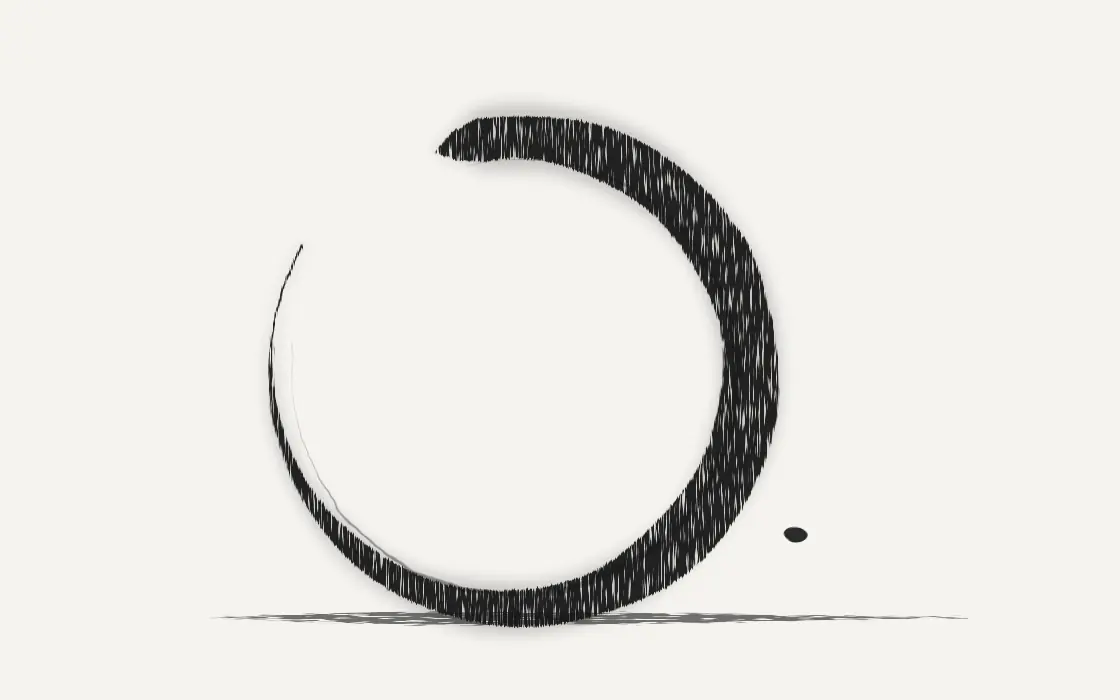
These three positions are joined into an arc that is neither closed nor symmetrical, because the Dantian is placed higher than the Coccyx Gate. This arc is called the Humility Gate (Khiêm quan).
Although the Dantian lies low in the abdomen, it is responsible for the frontal lobe of the brain. When the Dantian is full, the frontal lobe opens, and the practitioner attains mindfulness with clear awareness, and the mind becomes empty and bright, not distracted by deluded thoughts.
Although the Huiyin point lies at the bottom, it is responsible for the crown of the head. When the Huiyin is full, the crown opens, and the practitioner becomes sharp in wisdom, easily sees their own deeply hidden faults, and over time develops intuition.
The Coccyx Gate is responsible for the large region of the brain at the back. When the Coccyx Gate is full, the back of the brain opens, so that the practitioner enters deep absorption easily.
When the whole Humility Gate is full, the internal organs are gradually corrected, improved and nourished, and resistance to illness is raised. The functions of the kidneys, liver, heart and lungs are all strengthened. In particular the two legs become firm first, and slowly the two arms grow strong after.
3. Applying effort
To apply effort in practising this Qigong Mind Method, the practitioner must first have the foundation of Buddhist meditation, which includes the basic practices such as sitting in the correct posture, keeping the body supple and motionless, knowing the whole body clearly, contemplating the body as impermanent and illusory, and breathing out and in according to the Four Foundations of Mindfulness. This foundation must be consolidated for several years until it is firm.
The practitioner must also be someone who cultivates morality with basic attitudes such as reverence for the Buddha, compassion and love for beings, and humility to respect everyone. If an attitude of arrogance appears, Qigong practice must be stopped immediately, because an arrogant attitude will drag energy up violently from below the True Yin and, not long afterwards, ruin the brain.
Next, the practitioner must also constantly create much merit by helping people in daily life. If there is an opportunity, they should never spare effort or wealth in helping others. In the old days Shaolin Temple martial students had to do service work, carrying water and chopping firewood, to create a great deal of merit before going into intensive training.
When sitting down to practise Qigong, the practitioner begins as in the ritual for entering meditation, deliberately arousing the three or four basic intentions, and applies effort according to meditation for about 10 minutes before beginning to apply the Qigong Mind Method as follows:
The right hand is placed under the left hand as usual, but the two index fingers are interlaced to hold the hands securely.
The tips of the two little fingers touch each other and point at the Dantian. Touch only lightly, just enough, without pushing deep and without leaving the skin. This movement is used to locate the Dantian throughout the session. Keeping the two little fingers in place throughout the session makes us feel it is troublesome, but it is very necessary, so it must be followed.
On the in-breath, we also let the breath come in naturally without interfering, exactly as in Four Foundations of Mindfulness meditation, but the mind rests lightly at a single point, the Dantian. Because the two little fingers locate the Dantian, we can simply let the mind rest lightly there during the in-breath. It is extremely important that we rest only on the surface of the skin and do not put the mind even a fraction of a centimetre deeper inside the flesh. Entirely on the skin. Only on the skin. Someone may wonder: if the mind is placed like this, then where is the practice of knowing the whole body clearly from meditation? True, at that moment we no longer completely know the whole body clearly, but thanks to the years of knowing the whole body clearly, the notion of monitoring the whole body quietly remains. Not long afterwards, when the mind is still and free of deluded thoughts, the knowing of the whole body naturally appears again in a new, wonderful and firm state.
The second step is holding the breath. Holding the breath differs from stopping the breath. Stopping the breath is only stopping without closing the nasal valve. Holding the breath is closing the nasal valve, exactly as when we dive underwater, hold our breath and close the nasal valve so water does not enter the lungs. While holding the breath, our mind rests lightly at the Huiyin point. Remember again that we pay attention only on the skin, and do not put the mind a fraction deeper into the skin. We practise holding the breath with the mind resting at the Huiyin in this way for two or three months to become used to it, then change to the method of
firming the root (cố căn). While holding the breath, we firm the root once, or twice, according to each person's ability. The practice of firming the root is very important; it makes our brain stronger day by day.
- The third step is when the breath goes out; remember to let the out-breath go naturally, and we must not interfere or control it. While the breath is going out, we rest the mind at the Coccyx Gate (the bottom three vertebrae). Remember again that we rest the mind only outside, close against the skin, and must not put it deep into the vertebrae. Remember that we must not lead the breath along, must not pull, push, tense or hold on to anything. We simply change the place where the mind rests, gently, through the three different steps.
The signs that we are practising correctly are that the whole bottom area of the lower abdomen gradually warms up, the mind is light and empty, deluded thoughts are easy to control, and we gradually enter stillness. In daily life we have better health and a clearer mind. There are many other interesting results that each of us will feel when applying effort in training.
Now, in each meditation session, practising this Qigong Mind Method is itself practising meditative concentration, because the Qigong method helps us control deluded thoughts markedly more effectively, just as in the old days the Buddha entered absorption easily because he had abundant inner power.
In addition, at any free moment, we can find a place to "rehearse" for five, or ten to fifteen minutes, and it is very good. We have a mutually reinforcing cycle as follows:
The more we sit and practise, the more power we have.
The more power we have, the more we can sit.
If we sit little, we have little power. And with little power, we cannot sit for long. If our starting point is little power and so we cannot sit long, we will supplement by sitting many times. We will make use of any opportunity to sit, even if each sitting is only five or ten minutes. But thanks to sitting many times, our power increases gradually, so that when we come to the main evening or late-night session, we will be able to sit for a very long time.
After some months or years, we move to a higher step, which is:
On the in-breath, we rest the mind over the whole Humility Gate, that is, the whole stretch of the arc running from the Dantian to the Huiyin and the Coccyx Gate. Remember that this arc of the Humility Gate lies close against the outer skin and must not sink even a small fraction into the flesh.
When holding the breath, we still rest the mind at the Humility Gate but firm the root a few times. This practice of firming the root is done only during roughly the first 15 minutes; after that, when holding the breath, we no longer firm the root, but simply continue resting lightly at the Humility Gate.
On the out-breath, we also rest the mind only on the Humility Gate. Although all three steps rest the mind at the Humility Gate, when the mind enters absorption the whole of our body appears very clearly, like a Pyramid standing firm and solid. Our whole mind also appears empty, clear and pure, and secret, deeply hidden thoughts are quickly discovered. As for power, it increases gradually according to each person's conditions and merit.
Questions and answers
Question: Can one attain liberation by training Qigong in this way?
Answer: Whoever directs the mind towards seeking extraordinary power will not be liberated. Whoever directs the mind towards stilling the mind in order to reach selflessness will be liberated.
Question: Besides the full lotus sitting posture, can qigong be practised in other postures? Answer: We can follow and keep the mind at the Humility Gate while jogging, remembering to hold the breath in the second step. When sitting chatting with someone, we can still quietly keep the mind at the Humility Gate to make use of whatever little we can.
Question: Why is it called the Humility Gate?
Answer: Because it is the lowest, the humblest position. The lowest place is also where the body's source of energy arises. It is just as the practice of humility makes countless other virtues blossom along with it.
May our people, those with good hearts, all grow in power so as to live more beneficially.
Appendix
THE MEANING OF CESSATION (CHỈ) AND CONTEMPLATION (QUÁN)
We usually hear two kinds of meditation distinguished: Cessation Meditation (Thiền Chỉ) and Contemplation Meditation (Thiền Quán). In some schools, Contemplation Meditation is regarded as orthodox, while Cessation Meditation is regarded as heterodox. In practice, however, as in the traditional Nikāya scriptures, both kinds of meditation have equal value.
"Chỉ" means to stop
"Quán" means to examine
"Meditation" (Thiền) always means attaining a pure inner mind with no more thinking. Comparing the three meanings above, "Chỉ" seems closer to "Thiền". "Quán" seems more active.
1. Chỉ
The basic meaning of Chỉ is to stop; however, "Chỉ" also has many other meanings.
For example: when a deluded thought arises, we immediately give the mind the command "be quiet", and the deluded thought goes out at once. That command is Chỉ.
For example: on seeing something precious in gold or silver, greed arises in our mind. We tell ourselves at once, "Enough, no more greed!" Right then, the greed ends; telling oneself, warning oneself and restraining oneself in this way is Chỉ.
In the Nikāya scriptures, the Buddha often says to eliminate unwholesome states, to eliminate the defilements of the mind… Such elimination is also Chỉ.
Next, methods of resting the mind at a certain position also belong to Chỉ. For example: a practitioner rests the mind at the nose to follow the breath going out and in. Following the breath belongs to "Quán", but the resting at a position belongs to Chỉ.
For example: a practitioner rests in the palms of the two hands lying one upon the other and finds it very settling. Such resting also belongs to "Chỉ".
A practitioner rests the mind at the two regions at the back of the brain and feels it easy to control deluded thoughts from the moment they first arise. That too is Chỉ, although the controlling belongs to Quán.
A practitioner rests the mind at the Nguyên Quang point (four centimetres below the Qihai point) and feels the mind settle pleasantly.
A practitioner whose legs hurt during meditation feels it is not yet necessary to end the session and so rests the mind at the place of pain, to face the pain and practise bearing it without resistance. That too is Chỉ.
A practitioner whose mind is naturally easy to settle needs only to restrain it lightly a little at the start, after crossing the legs to sit, for the mind to enter absorption. The deliberate light restraint at the start is also Chỉ.
2. Quán
The basic meaning of Quán is to examine, but that examining is only correct when it brings the mind into absorption. If the more one examines the more agitated one becomes, then that contemplation is not correct.
Quán is examining an object on the basis of a principle.
For example: when a practitioner contemplates the body, they contemplate on the principle of impermanence, reminding themselves back and forth, unhurriedly, that this body is impermanent. Because of such examination, deep down the practitioner's mind is freed from attachment and clinging and gradually no longer gives rise to deluded thoughts.
Sometimes a practitioner contemplates outward and sees the world as a dream, an illusion, fleeting. Because of such examination, the practitioner's mind no longer craves the world and enters stillness. However, when turning outward, we easily "contemplate" everyone and every creature as illusory. That falls into the fault of losing compassion and looking down on beings. The karmic result of that fault is very heavy. Although we contemplate the world as illusory, the practitioner must give rise to compassion for all sentient beings.
Compassion is also an extremely important contemplation in Buddhism. Without the foundation of compassion, even if we attain absorption, it is still not Buddhism. Therefore in the first days of coming to Buddhism, the practitioner must steep themselves deeply and firmly in generous love for beings, and must develop compassion throughout life.
For the contemplation of impurity, one must contemplate one's own body and not the bodies of others. When one has contemplated one's own body as impure until it has become second nature, one naturally no longer craves the bodies of others. But if one contemplates the bodies of others as impure, it is like falling into the fault of disparaging people, and one will suffer the karmic result of strong craving later on ("what you hate, heaven gives you"). In fact the root of an undefiled mind that lets go of sensual craving is the merit of honouring the Buddha and respecting everyone. If we do not know how to honour the Buddha, do not know how to respect everyone, and think ourselves better… then our character will decline and craving will arise.
3. Practices that have both the meanings of Chỉ and Quán
There are practices that in fact include both Chỉ and Quán.
For example: the practice of contemplating the breath. Examining and following the out- and in-breath need not be accompanied by any principle. Since no principle accompanies it, it is very like Chỉ. Moreover, sometimes the practitioner rests the mind at the nasal passage to follow the breath, which makes it belong all the more to Chỉ. However, the alert awareness that follows can also be regarded as Quán.
The case of resting the mind at the back of the brain is the same. Resting the mind belongs to Chỉ, while the alert awareness that controls deluded thoughts belongs to Quán.
There are cases where an affliction or an unwholesome state arises in the practitioner's mind, such as craving, hatred or sorrow… and the practitioner immediately rests the mind right on that unwholesome thought to face it and see what it is and where it arises from, and right then the unwholesome afflicted mind dissolves. Resting the mind in this way can be called Chỉ; but the facing, the investigating and the questioning belong to Quán.
In the early practice of settling the body, the practitioner both knows the whole body and sees this body as false, which includes both Chỉ and Quán, although it leans more to Quán.
4. Quán and Chỉ changing back and forth
There are cases where the practitioner begins practice by contemplating impermanence. When the mind has settled, there is no need to contemplate any more; it is only necessary to hold the mind in one place at the back of the brain. (Resting the mind in front of the forehead easily gives off radiance, but also easily gives rise to conceit.) Thus in the early stage the practitioner practises Quán, but later it gradually turns into Chỉ.
In the case of a practitioner who finds it hard to gather the mind, who arouses the phrase of reciting the Buddha's name in order to repent. The thought of repentance like this also belongs to Quán. After a while they let go of the phrase and keep the mind settled again. That too is Quán changing into Chỉ.
In the case of a practitioner who follows the breath until the mind enters absorption, there is no more need to try to follow; the breath automatically draws the mind's attention to it, so that the mind settles naturally. This stage also belongs to Chỉ.
There is also the case of a practitioner who is gathering the mind peacefully and suddenly is struck by a deluded thought that is hard to restrain. The practitioner can no longer go on resting the mind, but must examine the cause. Only when the practitioner finds the fault that appeared a day or two before, and then wholeheartedly recites the Buddha's name to repent, does the mind gradually settle again. That too is Chỉ, but temporarily turned into Quán.
We can understand Chỉ and Quán through this illustration. When the country is not yet at peace, the king must plan, defend and clean up. That is Quán. Quán has the function of cleaning up and breaking the mind's clinging. When the country is at peace, the king sits quietly on the golden throne to rest and goes on observing lightly, and when needed simply gives commands. That is Chỉ. Chỉ has the nature of resting while still knowing clearly, and also of giving commands.
When Quán has settled the mind, it must naturally gradually turn to Chỉ to consolidate the power of concentration. Sometimes the mind gives rise to deluded thoughts and concentration runs into trouble, and then one must return to Quán to clear away the obstacles. Like the king, sometimes resting quietly, sometimes defending.
Practising meditative concentration is never always smooth and forward-moving. Everyone who practises meditative concentration sees the power of concentration advance and retreat many times. Therefore one must know how to apply effort flexibly, in combination, and not cling rigidly to Chỉ alone or Quán alone.
5. Chỉ and Quán with concentration and wisdom
Whether one practises Chỉ or Quán, the practitioner must reach the result of concentration of mind through the four levels of meditation that the Buddha repeated throughout his life of teaching. When one enters concentration, the mind is like practising Chỉ because it rests, but the power of alert, clear knowing is like Quán.
Many people who practise meditation gain settled concentration of mind but have nothing to present or expound. If someone asks, they answer according to their own practice, but speak simply and plainly, not knowing how to present it in an orderly, detailed way. Most such cases come from practising meditation by way of Chỉ, where the mind easily enters absorption. Only when wisdom opens (awakening) does the practitioner develop eloquence in questions and answers. But there are also cases where, even after awakening, this person still cannot teach the Dharma because the causes and effects are not yet complete and eloquence does not appear. In any case, whatever ability to teach the Dharma one has comes from merit. Some people who practise meditation have understanding and can already present and expound before the mind has entered absorption. Such cases come from practising meditation by way of Quán. The wisdom of Quán also brings forth understanding and quick-witted answers. The more such a person enters absorption, the more their understanding and eloquence grow. However, a practitioner in this case easily keeps a subtle mind that is hard to eliminate. One must settle deeply to eliminate the subtle mind in order to enter the First Dhyāna.
Sometimes people easily confuse understanding with wisdom. A person who has practised and studied and can speak fluently in presenting the teachings is only said to have understanding, not yet wisdom. Wisdom truly appears only after the practitioner is proficient in concentration.
Wisdom is also of two kinds:
The first kind of wisdom is like supernormal power: knowing the past and future, knowing others' minds.
The second kind of wisdom is seeing the Truth (Đạo Lý).
Lofty teachings such as the Four Noble Truths, the Twelve Links of Dependent Origination, the Seven Factors of Awakening…
Without the Buddha's wisdom, no one would even now have seen them.
The wisdom of supernormal power, though hard, is not very hard. The wisdom of seeing the Truth is what is truly hard, and necessary for humankind.
Many practitioners attain concentration and have supernormal powers, know many things in the world, yet sometimes still do not see the Truth thoroughly, and sometimes their teaching of the Dharma still departs from the Buddha's meaning. The wisdom to see the Truth is very precious and very hard. So we must distinguish the differences between:
Chỉ: stopping the mind in order to rest.
Quán: examining on the basis of the Truth the Buddha taught.
Understanding (kiến giải): temporary sharpness gained by study and quickness of mind.
Wisdom of supernormal power: a kind of spiritual insight that knows many things ordinary people cannot know.
Wisdom of the Truth: the wisdom that truly sees the truth, what is right in life and in the universe.
Concentration (Định): the result brought by Chỉ and Quán, in which the mind has no more deluded thoughts. Concentration has many levels.
Meditation verse
Meditation is taming the Mind
But to tame the Mind
One must regulate the Breath
To regulate the Breath
One must regulate the Body
Together with boundless Merit.
So the first step
Is to plant Merit deeply
Live gently and rightly
Following the wondrous Noble Path.
Enter meditation in full lotus
In the Buddha's own posture
Keep the whole body supple
And deeply motionless
When deluded thoughts arise
Making us forget the present
Then Merit
Helps us return at once
Then return to settling the Body
Look over the arms and legs
Is any place tensed and stiff
Or fidgeting at all.
Then know the Body is impermanent
One day it will "set out"
Crumble into dust and sand
The bones turn to powder and fly away.
Be patient in settling the Body
No need to hurry
Settle the Body until it is second nature
And the Way will be near.
Then see in the Body
The breath going out and in
Guarding our life
Not leaving for a single minute.
There are two extremes
That make the breath imperfect
One is forgetting the breath
The other is breathing busily.
Forgetting the breath, forgetting to practise
The mind sinks into darkness
So we must try to remember
Each wondrous breath.
The breath comes in, know it comes in
The breath goes out, know it goes out
Do not try to control it
According to our own wishes.
Sometimes the breath is plentiful
Sometimes there is hardly any
But only know it clearly
No need for anything more.
The breath belongs to the Body
When we know the whole Body clearly
We see the breath as well
No need to hesitate.
Remember one thing well
However the breath may be
It must not be controlled
Just know it, that is all.
Know clearly the in-breath
Know clearly the out-breath
Know the whole lower body
Alert and at peace.
Still keeping the body steady
Motionless and light
And knowing each breath
The mind stops its wandering
Many states of Mind
Subtle and strange
Appear in turn
And will make us misunderstand
Seeing the mind's consciousness empty
The heart utterly free
We will think we have attained
Some noble fruit
In truth we are still
Standing weary outside the door
Not yet through the gate
Of the Supreme Temple
In the deep temple
There is a wondrous seat
Called Selflessness
That has waited for us a long time
Namo Our Teacher Śākyamuni Buddha (3 times)