The concept of karma and its results
From Karma and its resultsAbout 20 min read
"Nghiệp Báo" (karma and its results) is short for "karma and its consequences", or "karma and the results of karma".
Karma is the activity of thought, speech and action of all sentient beings, which can produce a result of joy or suffering later on. If through good karma we bring joy to others, we will later receive joy as the result. If we give to the poor, we will have plenty of wealth. If we care for the health of the sick, we will be healthy. But if through bad karma we sow suffering for others, suffering will return to us. "An eye for an eye, a tooth for a tooth" (* the Bible) (Karma and its Results
Struggle). That is the invisible fairness that governs everything.
Sometimes we also call the law of karma the Law of Cause and Effect. Karma is regarded as the cause and its consequences as the effect.
However, the name Cause and Effect has too wide a scope, covering every other form of cause and effect in life, physical, social, psychological... The name Karma and its Results is specific to good and evil alone.
For example, say that fire is the cause and boiling water the effect. This cause and effect has nothing to do with karmic consequences. Or fuel is the cause and the movement of a vehicle the effect, since the fuel makes the vehicle start. This causal interaction differs from the cause and effect of karma.
A seed is sown in the ground, certain conditions such as water, fertiliser and light are added, and then the seed sprouts, becomes a plant and bears fruit. This causality in plants is also far from the cause and effect of karma, even though spiritual teachers often use this image to illustrate the path of karma.
Scientific forms of cause and effect are easy to observe, whereas the cause and effect of karma is invisible and works across many lives of rebirth, so it cannot be observed with the naked eye. For example, increase in population is a cause that leads to the effect of socio-economic decline. This can be demonstrated very clearly. That is why sociologists urge everyone to reduce population through family planning.
Or the use of fossil fuels such as oil, gas and coal raises the amount of carbon dioxide in the atmosphere and produces the greenhouse effect, disturbing the Earth's ecology,
causing much harm to the lives of all humankind. Types of cause and effect like these are not karma and its results, yet they clearly affect people's suffering and happiness. What about the use of fossil fuels polluting the environment, or the use of Freon gas making a hole in the ozone layer of the atmosphere? The ozone layer protects the earth from harmful cosmic rays. But volcanoes and industrial fluorine gases have thinned and torn this ozone layer, endangering humankind.
Even arhats, who are regarded as having nothing more to learn and no doubt about liberation, still always need knowledge if they return to save people. Mr Krishnamurti, a spiritual teacher of our age, never neglected to follow the progress of science in the world.
An abbot, for lack of knowledge, applied a mistaken monastic rule that harmed the health and spiritual life of the community. A preacher, for lack of knowledge, explained the teachings in a way that contradicted science, causing superstition and lowering the worth of the path.
All of them will later have to bear dangerous karmic consequences.

Then, excessive enjoyment of comforts leading to the destruction of the Earth's ecology is also regarded as a considerable wrongdoing. People should learn to live simply, closer to nature, rather than keep demanding luxurious comforts without regard for the limited endurance of the environment.
Or a person who commits theft or murder is arrested by the authorities. This social cause and effect is just like the law of karma and is a demonstration of karma and its results.
Or a doctor who devotedly treats patients is praised and promoted. This social cause and effect is no different from the law of karma.
But it is still not the law of karma, because it has not reached absolute fairness. A cunning criminal can still deceive the law. Countless cases remain unsolved. And there is no shortage of dedicated, kind-hearted people who are persecuted because they do not side with wrongdoers.
Those who lead governments always try to find fairness for society, but since ancient times the fairness that people create through the framework of law has achieved results only in part. For example, a presiding judge, out of personal bias, goes easy on one person and increases the sentence of another. For the present, everyone must accept the temporary fairness established by people and by society.
Many religions have put forward the absolute justice of God, calling on people to be at ease in the face of the injustices that still fill society, because God will judge everything again after death or after the end of the world.
Here, with the law of karma, whatever people do to others returns to them fairly, certainly and reasonably.
With easily understood reasoning, we can say that a good karma creates a joyful result and a bad karma creates a painful result. For example, a person who often shares material things will become wealthy, and a person who is often arrogant will fall into a lowly position.
However, to understand what is good and bad we must depend on the circumstances of the age. Ordinarily we consider an action good when it brings joy to others and is praised by many people.
Consider the case of a primitive tribe with a custom of killing a beautiful girl each year as a sacrifice to the gods.
The chosen girl also feels honoured. For them this action is good, while elsewhere it is utterly abhorrent. So what counts as good and evil is only relative and varies with circumstances.
Or parents scold and punish a child, which makes the child uncomfortable and seems wrong, but in truth it brings the child lasting benefit later on.
Ideas of good and evil vary according to many conditions, whereas the law of karma is unchanging.
Whatever we do to others will return to us fairly.
For example, in the tribe that kills people as sacrifices, the law of karma does not judge good or evil; it silently arranges for those who kill to be put on the pyre at another time.
If we radiate loving-kindness, we will become saints. If we spread knowledge, we will become a scholar. If we spread methods of meditative concentration, we will attain deep concentration. Whatever we bring to others returns to us. Those who forget themselves to help everyone will have everything in abundance.
However, with these ordinary eyes no one can witness how a karmic cause will lead to a karmic result.
A robber murders someone, evades the law, and then everything fades and the case is never solved. Is it certain that he will suffer some fitting retribution in the future? Is it certain that he will fall into a ravine, be hit by a vehicle, or be killed in turn by someone else?
Or a child is born into a wealthy family. Is it certain that in a previous life they gave and helped everyone? Is it certain that they made offerings to holy beings?
It is precisely the span of time in between that makes the law of karma mysterious, hard to see and hard to accept.
When we help someone, they feel indebted and later repay the kindness. This cause and effect is easy to see because it is simple. But sometimes we meet ungrateful people who take no notice of us.
Or in the past we made a mistake and harmed someone, who bore resentment and looked for a chance to harm us. This seems fair and consistent with the nature of karma. But sometimes we meet generous people who forgive and do not seek revenge.
So the law of karma does not depend on people's gratitude or ingratitude, resentment or forgiveness. It follows its own path silently, regardless of changes in human psychology.
It is like a secret mirror reflecting light. A person who does not know about the mirror up high would be amazed that a lamp here, separated by several layers of walls, produces a glow on the other side. In the same way, not seeing the mirror that reflects karma, we are amazed that a good or bad karma here, separated by differing time and space, produces a joyful or painful result somewhere else.
The mirror represents the ABSOLUTE ESSENCE of the universe. The reflecting property of the mirror represents the law of karma. The lamp represents the karmic cause. The glow on the other side represents the result, and the layers of wall represent spaces near and far. The height of the glass is spiritual depth, not physical height.
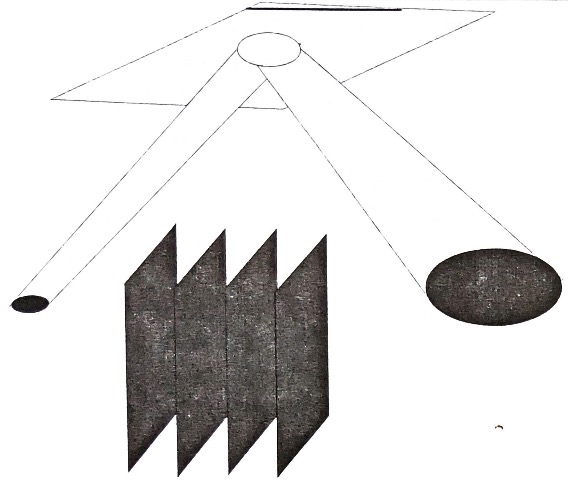
Not knowing about this mirror of Essence, we know still less about its karmic reflecting property. Faced with people's suffering and happiness, we cannot understand the original cause. Looking at good and bad deeds, we cannot foresee how the result will appear.
Only holy beings who have fully realised the path, who have completely entered the Absolute Essence and attained union with the whole universe, can see clearly the reflecting nature of perfectly fair karma.
The Buddha called the ability to see clearly the path of karma the Knowledge of the Divine Eye. So the divine eye is not a heavenly eye for looking at scenery near and far for pleasure. Here, the divine eye means one of the many abilities of one who has realised the path, who can see in full detail how karma operates in producing later results.
"As a person on a high building at a crossroads watches people passing by, so, with the pure, supernatural divine eye, the arhat sees clearly everyone's actions and their results. Those who create good karma will be born in a place of peace and joy. Those who create bad karma will be born in a place of suffering."
Before the Buddha was born, in India, Heaven symbolised the highest greatness in the universe. So the Buddha used the terms divine eye and divine ear to mean the highest ability of understanding of one who has realised the path. After the Buddha's time, in Buddhism, the concept of "Heaven" came to carry a lesser value, so the commentaries produced some more suitable new terms such as the eye of wisdom, the eye of the Dharma and the eye of the Buddha.
At that point the term divine eye came to be understood as lower than its original meaning. In fact, in the Buddha's lifetime, when the Buddha used the term divine eye he was alluding to the highest value, none higher.
If we suddenly asked a holy being who has realised the path about some specialised matter, they might still not know. Why would they not know, when the ability of the divine eye is transcendent and can be called absolute?
In truth the Essence has two qualities: stillness (cessation) and penetration. Complete stillness and complete penetration.
A person who has realised the path can, as they wish, dwell in absolute stillness and need not know anything, because for themselves, knowing or not knowing is of no importance. But when there is a matter they need to look into in order to help beings, they turn towards the quality of penetration and at once everything is laid bare.
If we ask them exactly about what they have observed in concentration, they will answer clearly. Otherwise they still do not know.
Having "observed" the rebirth of many people, one who has realised the path understands the nature of karma better than we do. They understand clearly why one person must have a woman's body, why one is intelligent, why one suffers lowliness. In daily life they are always careful with every action, because their wisdom always shines and admits no slightest oversight. Their whole life is a complete picture of ethics. Seeing people constantly creating karma, turning right to do something wrong, turning left to say something wrong, bowing down to give rise to a bad thought, out of compassion they pity them deeply, knowing that they will meet much misfortune in the future.
For a holy being who has realised the path, the law of karma is an obvious truth about which there is nothing left to doubt or debate. They declare and teach about karma with conviction and eloquence, so that we believe and understand and know how to live a more ethical life. Followers of Buddhism and of Indian religion believe deeply in the Law of Karmic Cause and Effect because they have been taught about it so much by their founding teachers. Moreover, the fairness of karma accords with the human conscience.
In the depths of their hearts everyone feels that the wicked deserve punishment and the good deserve reward. So with the law of karma their longing is answered and they are reassured, even though life is unjust and people show favouritism. In the end the law of karma will settle everything fairly.
Precisely because the law of karma accords with the human conscience, even people with no religious inclination quietly accept the reality of this Law of Cause and Effect. They believe there is a silent fairness governing human life, so that good people enjoy much good fortune and wicked people suffer much misfortune.
An English proverb says:
"Man reaps what he sowed" (People reap what they sow). Or the Vietnamese say "Live kindly and meet kindness" and "Sow the wind, reap the whirlwind"... All reflect a deep belief in this law of karma.

There are only two kinds of people who do not believe in karma: the wicked, who do not want to believe because they fear having to pay karmic consequences later, and those who demand a logical proof and do not trust the intuition of the inner mind.
In the film "Star Wars", a scientist taught his pupil that to become a Jedi knight he must trust the intuition of the inner mind more than what the eyes and ears see and hear, because there are truths that the ears and eyes cannot perceive, which only intuition can sense.
It is the same here: while science does not yet have the power to prove the law of karma, if we do not use this intuition we cannot understand the presence of the law of karma silently governing our lives in every subtle moment. On one hand we try to find proof of the law of karma; on the other hand we must also know how to use the intuition of the inner mind to believe in and understand this wonderful law.
Science today is still too limited and cannot yet know much about the principles of the universe. We can photograph an atom and know nearly all the elementary particles of the atom, but this is only a small field compared with the countless other laws. For a long time people thought Newton's laws (1642-1727) were perfect. When Einstein (1879-1955) put forward the theory of relativity, everything changed entirely; science entered a new era, requiring extremely abstract thinking that left the scientists of the day dumbfounded. Earlier, Goethe had praised Newton in these lines:
"Of old the universe was dim and dark
But God said, Let Newton be
And all things became light and ordered."
Later someone else added in jest:
"Then Satan appeared and said: Let Einstein be
And all things sank into darkness again."
With Newton, the theories of gravity and motion are very concrete and clear, like two and two make four. But with Einstein, the theory of the universe is extremely abstract and endlessly changeable. For example, he held that space and time change according to many conditions such as the gravitational field, velocity and density. A person travelling at a speed like the speed of light would feel that a few hours had passed while at the same time on Earth several decades had passed. Or he held that space and time are linked with the matter of the universe. If no matter were left, not a single star, everyone would think there was still a vast, endless expanse of space, but he said there would be no space and no time at all.
Such a theory is extremely abstract and goes beyond the traditional human way of thinking, which is used to concrete things. To understand Einstein's theory, scientists had to rely on intuition more than on the ordinary reasoning of consciousness.
Einstein's reasoning opened a new horizon for thinking in science. People gradually grew used to strange new truths that cannot be recognised with the eyes, but can only be understood with intuitive wisdom.
Although thanks to Einstein science took a long stride, to prove the path of karma we must still wait for many discoveries by later geniuses.
Science today does not yet know all the properties of the brain, with more than 10 billion neurons (as of 1991).
How neurons work together to resolve thought signals, and how metabolism proceeds so rhythmically, are still a mystery. Moreover, the subjective nature of the brain remains foreign to objective study from the outside. Why does the brain form such a fierce survival instinct, so that people always strenuously try to maintain their own lives? How can the wish of a psychic make clouds in the sky disperse?
For instance Ignatenko, in Ukraine, raised a hand to the pitch-black sky with the single intention "Clouds, disperse." A few minutes later the clouds gradually dispersed before everyone's eyes, and the sun began to break through.
Countless psychic phenomena astonish scientists and cannot yet be explained.
Then flying saucers (UFOs) come from somewhere and go again at leisure, by methods of travel beyond the understanding of Earth's people. How could they come here after crossing a journey of several hundred light years? (The constellation Veda is 100 light years away. The constellation Orion is 1,300 light years away.)
All of it remains a mystery, which means that science still has many limits and cannot yet understand. If anyone demands that today's scientific reasoning be used to prove the law of karma like a rigorous mathematical equation, they will be disappointed. That day is still far away. In 1965 the mathematician L. A. Zadeh put forward the theory of FUZZY SETS (Fuzzy Logic) to take mathematics into abstract territory. This theory is now being applied in modern computers to create intelligent robots, and in sociology, linguistics, medicine, biology and so on, that is, in abstract fields.
It can be said that science is gradually entering abstract fields beyond what the ears and eyes concretely see and know. This is a welcome starting point, and truth is always very abstract; only in this ultimate truth can the reflecting nature of karma hope to be fully revealed.
To prove the reality of karma, science needs to expand into many other fields, more diverse, more abstract and more universal. With this small book we have the ambition to suggest a process towards that proof by combining elementary knowledge of Einstein's theory of relativity, knowledge of the unconscious and of the biological field, and the Buddhist concept of the Essence of Nirvana. Our understanding and presentation are indeed far too elementary, simple and slight, but we hope they will cast some faint rays of light that help people believe more in the reality of the law of karma while waiting for the great discoveries of others. After all, in the wild darkness of night, even a few rays of light can gladden a traveller searching for truth.